
Independent Bristol drainage engineers · Checkatrade approved
Cracked, displaced, root-damaged or collapsed pipework repaired from inside the drain wherever possible — so the garden, the driveway and the patio stay where they are. We only dig when there’s genuinely no alternative, and we’ll show you the footage that proves it.
Already had a survey elsewhere? Send us the footage and we’ll quote from it.
Patch repair
from £[XX]
Full pipe reline
from £[YY]
Excavation
Most no-dig jobs
Guarantee
Every quote is based on camera footage, and you get a copy of it.
Your garden stays where it is
We show you the fault before pricing it
[X-year] guarantee on lined sections
Evidence in the format insurers accept
The diagnosis
Six faults account for nearly every repair we carry out in Bristol. Which one you have decides whether it can be lined, patched, or has to come up.
Roots enter at a joint looking for moisture, then thicken and force it apart. Cutting them out clears the drain but leaves the opening — which is why it comes back. Lining the section seals the joint so there's nothing left to get into.
Ground movement, heavy traffic above, or simply age. A hairline crack lets silt in and effluent out. Left alone it becomes a fracture, and a fracture becomes a collapse.
Sections that have shifted out of line, leaving a lip that catches everything passing. Very common in Victorian clay runs where the ground has moved over a century.
The pipe has failed structurally and lost its shape. Sometimes still linable, often not. This is the one case where excavation is usually unavoidable, and we'll say so plainly.
A section laid at the wrong gradient, or one that has sagged. Water sits rather than runs, silt settles, and it blocks again and again. Clearing never fixes it — the profile has to be corrected.
Older internal stacks and some external runs are cast iron, which scales and corrodes from the inside. Descaling buys time; lining gives it a new inner surface without taking the stack out.
All six are found the same way — with a CCTV drain survey. We won’t quote a repair we haven’t seen on camera.
Your options
Which one applies depends entirely on what the camera shows. Any firm quoting excavation before surveying is guessing.
Most drain repairs in Bristol can be done from inside the pipe, without digging anything up.
The exceptions are genuine collapses, pipes that have lost their shape entirely, and runs where access is impossible. Everything else — cracks, fractures, root damage, displaced joints, corroded cast iron — is usually a lining job.
The difference matters financially as well as practically. Excavation means breaking out a driveway or lawn, then reinstating it, and the reinstatement is frequently the larger half of the bill.
Our rule: no-dig first, excavation last, and the footage on the table either way.
Method
When it’s used
Patch lining
A single crack, fracture or displaced joint. A resin-soaked patch is positioned over the fault and cured in place. Usually a few hours.
Full reline (CIPP)
Multiple faults along one run, or pipework at the end of its life. A liner is drawn through the whole length and cured, forming a new pipe inside the old one.
Excavation
True collapse, total loss of shape, or a section that can’t be reached from a chamber. Dig, replace, backfill and reinstate the surface.
Prices vary with depth, length, access and how much reinstatement is needed. Every quote is fixed before work starts.
Before — fracture found on survey
After — new pipe inside the old one
No-dig repair
A resin-soaked liner is drawn into the damaged pipe and cured hard in place, forming a new pipe inside the old one. No trench, no reinstatement.
1
Camera first, always. We show you the fault, its position along the run, and quote a fixed price against what’s on screen.
2
The run is jetted clean and any roots or scale cut back. A liner won’t bond to a dirty pipe, so this stage decides whether the repair lasts.
3
The resin-soaked liner is drawn in, inflated against the pipe wall and cured hard. It follows the existing route exactly.
4
A second camera run afterwards, so you can see the finished liner. That footage is yours, and it’s what the guarantee is written against.
1
Tell us your postcode and what’s happening. We’ll say honestly whether it sounds like today or later in the week.
2
On site we work out where the blockage actually is, before anything gets pushed further down the pipe.
3
One fixed figure, told to you before we start. If you’d rather not go ahead, there’s nothing to pay.
4
Cleared and flow tested while we’re still there, then we explain what caused it and how to stop it happening again.
On site — preparing the liner
Afterwards — nothing dug up
Reviews left on Google by people whose drains we’ve actually cleared.
EXCELLENT Based on 126 reviews
 Posted on Google

 Becky FrapeVery straight forward, no hidden costs, very friendly and super helpful. Highly recommend!Posted on Google
 Chris RentyTony at Flow Shure is fast to act on a drain issue and came to my support to fix a problem not just once but a second time at no extra expense 6 months later at short notice. He has provided the best service I've ever had from a tradesmen.Posted on Google
 HelenThis is the second time SureFlow have come to my rescue, as ever, quick, efficient - gets the job done, what more do you need?!Posted on Google
 Adam RiderGreat service and quickly got our slow draining shower sorted - thank you 👍Posted on Google
 Janet AdamsAntony was very prompt, efficient, and friendly. The problem was sorted very quickly.Posted on Google
 VICKI whittalAttended on time and solved the drainage issue promptlyPosted on Google
 Laura ChapmanResponsive, timely and clear communication throughout. Quick appointment and efficiently sorted the problem. Would use again and would recommend.Posted on Google
 Katherine LauQuick service and professional.Posted on Google
 Birsen OskayWe reached a solution very quickly. It was a professional job; thank you. I recommend it to everyone.
No surprises
Patch repairs in Bristol, full pipe relining, and excavation.
The honest answer is that it depends on what the camera shows — which is exactly why we survey before quoting rather than after. Depth, length, access, and how much surface has to be reinstated are what move the figure.
Patch repairs
Already have survey footage from another firm? Send it over and we’ll quote from it.
Before you pay
Three parties can end up paying for a drain repair: you, your insurer, or Wessex Water. It’s worth establishing which before anyone starts work.
Wessex Water is responsible for shared lateral drains and public sewers. If the damaged section serves more than one property, the repair is normally theirs rather than yours. Tracing the run during the survey tells us which it is, and we’ll tell you plainly — including when that means we’re not the ones you should be calling.
Your insurer may cover damage caused by an event rather than by age — subsidence, ground movement, or accidental damage during building work. Gradual deterioration and wear are usually excluded, but policies vary and it costs nothing to check. Claims need footage and a written report, which we produce as standard.
You are responsible for the drain that serves only your property, within your boundary — which is most private repairs.
Cause of damage
Who usually pays
Damage on a shared drain
Wessex Water
Subsidence or ground movement
Often the insurer — check the policy
Accidental damage during building work
Insurer or the contractor responsible
Root ingress and gradual wear
Usually the property owner
Age and deterioration
Usually the property owner
General guidance only — your policy wording and the specifics of the run decide it. Check with Wessex Water or your insurer.
Coverage
Most of our repair work is in central and north Bristol, where jointed Victorian clay pipework and mature street trees make root damage and displaced joints routine rather than unusual.
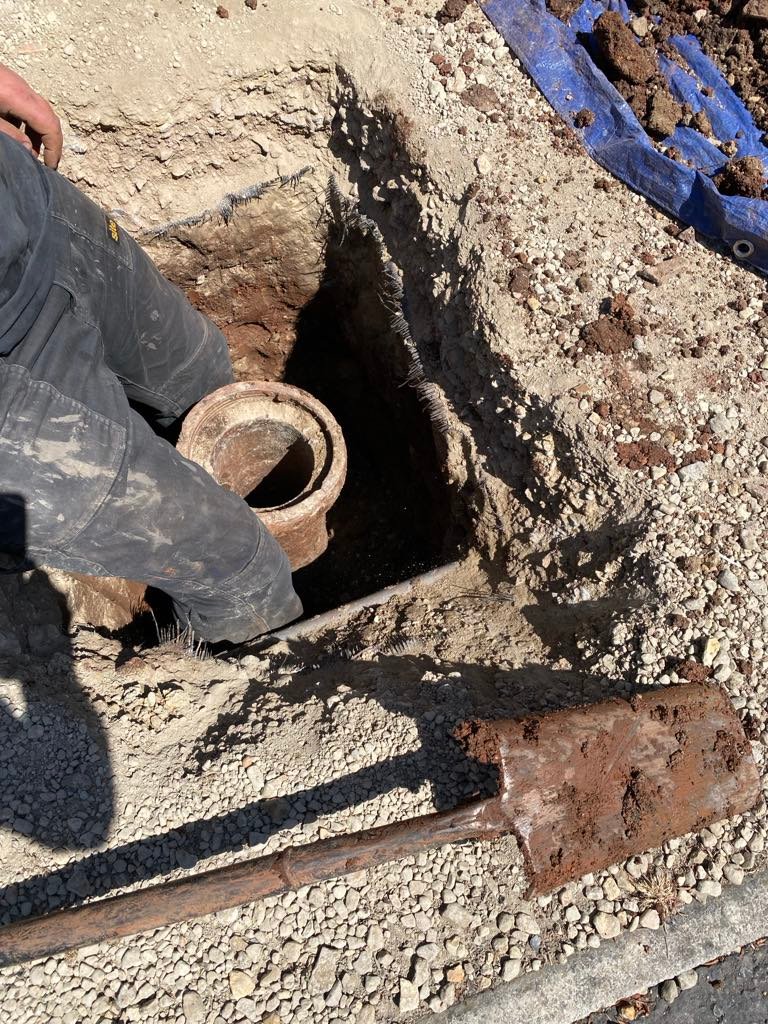
Excavation in progress
Straight answers
Patch repairs start from £[XX], full relining from £[YY], and excavation from £[ZZ]. The price is fixed before work starts.
What moves it is depth, the length of the damaged run, how accessible it is from a chamber, and how much surface has to be broken out and reinstated. On excavation jobs the reinstatement is often the larger part of the bill.
Usually, yes. Cracks, fractures, root damage, displaced joints and corroded cast iron can nearly always be repaired from inside the pipe, either with a patch over a single fault or a full liner along the run.
The exceptions are a genuine collapse, a pipe that has lost its shape completely, or a section that can’t be reached from a chamber. We’ll show you the footage that determines which it is.
Most no-dig repairs are a single day on site, and many patch repairs take only a few hours including preparation and curing. Excavation work takes longer, mainly because of reinstating the surface afterwards.
A correctly installed cured-in-place liner is a long-term structural repair, not a patch-up — it forms a new pipe inside the old one, with no joints for roots to get into.
We give a [X-year] guarantee on lined sections, with the post-repair footage as the record of what was installed.
Sometimes. Policies more often cover damage caused by an event — subsidence, ground movement, accidental damage during building work — than damage caused by age or gradual wear, which is usually excluded.
It costs nothing to check, and claims need footage plus a written report. We produce both as standard, in a format insurers accept.
Then it’s likely a shared lateral drain, and in this area that’s normally Wessex Water’s responsibility rather than yours — which can mean the repair costs you nothing.
Tracing the run during the survey establishes what the pipe serves. We’ll tell you before you pay for anything, including when it means calling them instead of us.
Yes, and you should be wary of anyone who quotes a repair without one. Without seeing the fault there’s no way to know whether it’s a patch, a full liner or a dig — and those are very different prices.
If you already have footage from another company, send it over and we’ll quote from that.
Usually, yes — that’s precisely where no-dig repair earns its keep. A liner follows the existing route, so a run beneath a block-paved driveway, a patio or an extension can be repaired without touching the surface above it.
Where the pipe has genuinely collapsed under a structure, we’ll set out the options honestly, including what reinstatement would involve.
Related
Every repair starts here. The survey identifies the fault, its position and its severity — and the footage is what the quote is written against.
If it's blocked as well as damaged, clearing comes first. A camera can't assess a pipe it can't see through.
The pipe is jetted clean before any liner goes in — resin won't bond to a dirty pipe, so this stage decides whether the repair lasts.
If you already know what’s wrong, we’ll quote from your existing survey. If you don’t, we’ll find out first and quote against what we see — never the other way round.
Prefer to send a photo? WhatsApp 07507 551514
Sending survey footage? admin@flowsuredrains.co.uk