- Home
- Drainage services
- Commercial drainage
Commercial drainage in Bristol
Scheduled jetting, grease line management and emergency cover for pubs, restaurants, HMOs, offices and managed property. When commercial drains fail, the cost isn’t the call-out — it’s the hours you’re shut. Planned maintenance is how you stop paying it.
Managing multiple sites? Send us the addresses and we’ll price the portfolio.
The short answers
- Reactive call-out
- Planned contracts
- Out of hours
- Payment
- Attendance
Multi-site portfolios priced per property, not per call-out.
Scheduled, not reactive
Visits when you choose, not mid-service
Reports after every visit
Records for compliance and landlords
Public liability insured
Certificate and RAMS on request
Bristol-based
Independent, not a national franchise
The commercial case
The call-out is the cheap part
A blocked drain in a commercial kitchen doesn’t cost you a call-out fee. It costs you a service.
If the drains back up at 6pm on a Friday, you’re not comparing our price against a competitor’s — you’re comparing it against covers you can’t serve, staff you’re paying anyway, and customers who booked somewhere else next time. In a busy Bristol restaurant that’s several thousand pounds before anyone’s turned a wheel on a jetting unit.
The same maths applies to an HMO with one bathroom out of use, an office with a closed toilet block, or a retail unit that fails a spot inspection.
Almost every one of those failures is predictable. Grease lines build at a known rate. Shared runs in converted properties block on a known cycle. The only variable is whether you find out on a Tuesday morning by appointment, or on a Saturday night by disaster.
Reactive
Planned
Happens mid-service
Happens when you’re closed
Closure while we work
No disruption to trade
Whoever is available
Engineers who know the site
No record of the drain’s history
Report after every visit
Unbudgeted, unpredictable
Fixed annual cost
Planned visits also catch structural faults early, while they’re still a lining job rather than an excavation.
Who we work for
Sectors we cover in Bristol
Different premises fail in different ways. These are the patterns we see most across the city.
Restaurants, pubs and cafés
Grease is continuous and unavoidable, however careful the kitchen is. Gloucester Road, Whiteladies Road, Park Street and the Harbourside all run on drainage that was never designed for current volumes.
HMOs and student housing
One original Victorian drain now serving four or five kitchens and bathrooms. Blockages are more frequent and affect more tenants — and wipes are a constant in shared houses.
Managing agents & blocks
Converted buildings with shared laterals, absent freeholders and unclear boundaries. We trace what serves what, so you know which repairs are yours and which are Wessex Water's.
Offices and retail
Lower volume, but a closed toilet block empties a floor. Usually annual maintenance plus reactive cover, with attendance arranged around opening hours.
Schools and care settings
Heavy, concentrated use in short windows, and no tolerance for facilities being out of action. Work scheduled around term dates and quiet periods, with DBS-checked attendance where required.
Industrial and trade units
Interceptors, yard gullies and surface water drainage. Silt and debris rather than grease, but the same principle — scheduled clearance costs less than a flooded yard.
What a contract covers
Planned maintenance, in practice
Four things happen on every scheduled visit. None of them require you to be there.
1
Jet the known lines
Grease runs, shared laterals and gullies cleared back to full bore before they restrict, at a frequency set by how the site actually behaves.
2
Check the chambers
Every accessible chamber lifted and inspected. Standing water, silt levels and root growth all show a problem developing long before it stops the drain.
3
Camera where needed
If something looks wrong, we survey it rather than guess. Catching a displaced joint early is the difference between a liner and an excavation.
4
Report and record
A written record of what was done and what was found, building a history of the site. Useful for compliance, for landlords, and for arguing a case with an insurer.
1
You call us
Tell us your postcode and what’s happening. We’ll say honestly whether it sounds like today or later in the week.
2
We find the problem
On site we work out where the blockage actually is, before anything gets pushed further down the pipe.
3
We agree the price
One fixed figure, told to you before we start. If you’d rather not go ahead, there’s nothing to pay.
4
We clear and prove it
Cleared and flow tested while we’re still there, then we explain what caused it and how to stop it happening again.
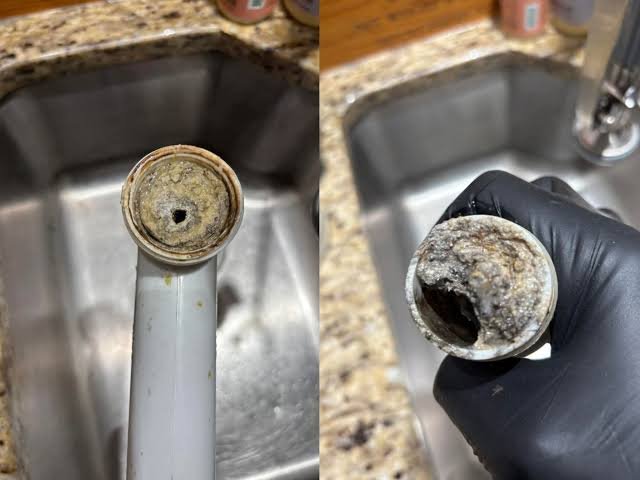
The problem — grease on a commercial run
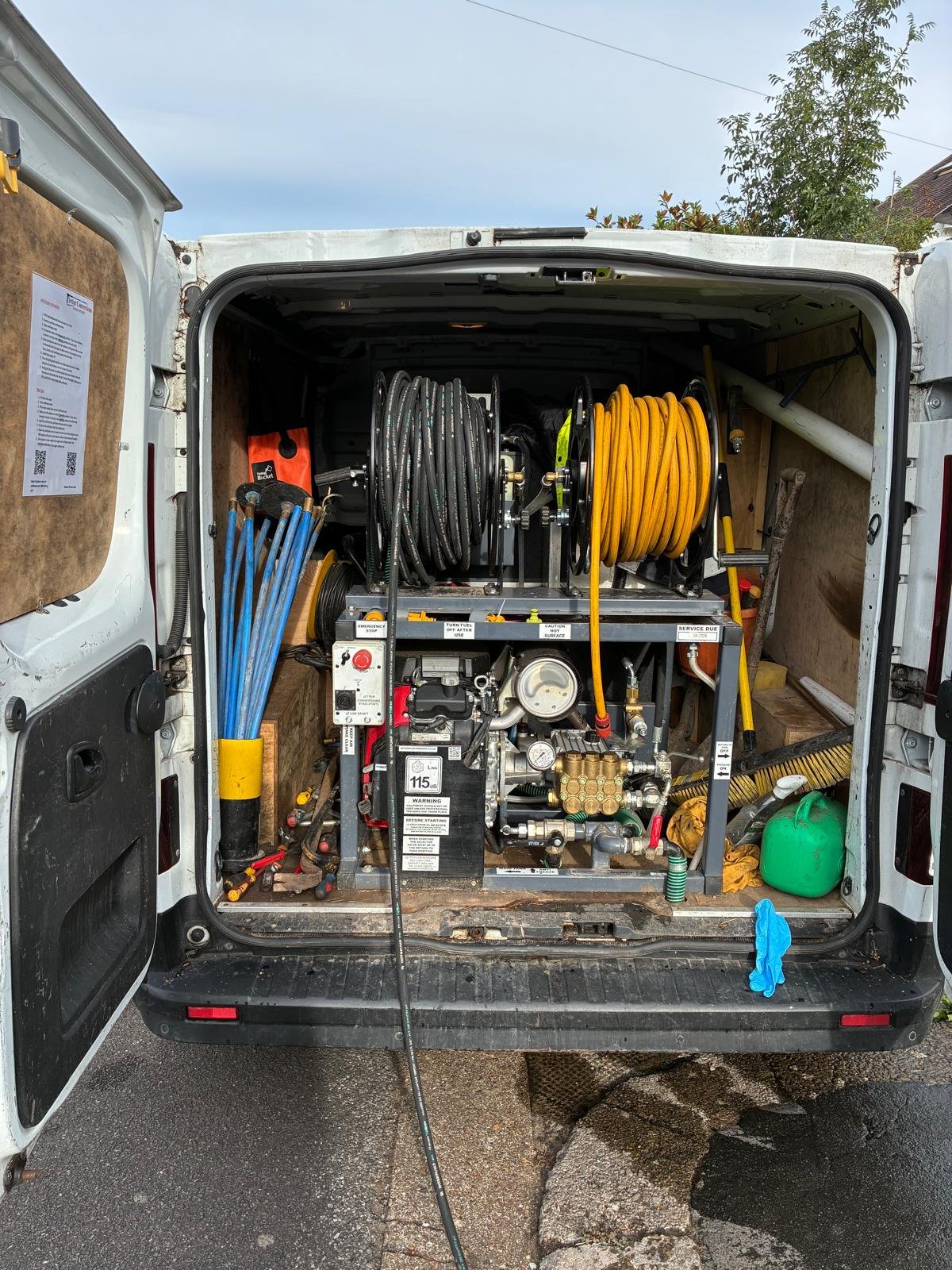
The solution — before you open
What Bristol customers say
Reviews left on Google by people whose drains we’ve actually cleared.
EXCELLENT Based on 126 reviews
 Posted on Google

 Becky FrapeVery straight forward, no hidden costs, very friendly and super helpful. Highly recommend!Posted on Google
 Chris RentyTony at Flow Shure is fast to act on a drain issue and came to my support to fix a problem not just once but a second time at no extra expense 6 months later at short notice. He has provided the best service I've ever had from a tradesmen.Posted on Google
 HelenThis is the second time SureFlow have come to my rescue, as ever, quick, efficient - gets the job done, what more do you need?!Posted on Google
 Adam RiderGreat service and quickly got our slow draining shower sorted - thank you 👍Posted on Google
 Janet AdamsAntony was very prompt, efficient, and friendly. The problem was sorted very quickly.Posted on Google
 VICKI whittalAttended on time and solved the drainage issue promptlyPosted on Google
 Laura ChapmanResponsive, timely and clear communication throughout. Quick appointment and efficiently sorted the problem. Would use again and would recommend.Posted on Google
 Katherine LauQuick service and professional.Posted on Google
 Birsen OskayWe reached a solution very quickly. It was a professional job; thank you. I recommend it to everyone.
Commercial terms
Contracts and pricing
Reactive commercial call-outs start from P.O.A. Planned maintenance contracts start from P.O.A. per visit, priced by site rather than by drain.
We price a contract after seeing the premises, not before. A single-kitchen café and a four-storey converted block need different frequencies and different work, and quoting either without looking is guesswork.
- Invoice or purchase order — no card payment on the day required
- No out-of-hours premium, so early mornings and after-close cost the same
- Attendance without a keyholder where access can be arranged
- Multi-site portfolios priced per property, with one point of contact
- Insurance certificate and RAMS provided on request
P.O.A
Send us the address and we’ll come and look before quoting. There’s no charge for that visit.
Worth knowing
Your drainage responsibilities
Businesses and landlords carry obligations around drainage that most people only discover when something has already gone wrong.
Fats, oils and grease. Under the Water Industry Act 1991, it is an offence to discharge anything into a public sewer that is likely to damage it or interfere with the free flow of its contents — which includes fat and grease from commercial kitchens. Water companies can require premises to fit and maintain grease management equipment, and can take enforcement action where a business is causing repeated blockages downstream. Wessex Water publishes its own guidance for food businesses in this area.
Landlords and HMOs. Section 11 of the Landlord and Tenant Act 1985 places a repairing obligation on landlords covering, among other things, the installations for sanitation — basins, sinks, baths and sanitary conveniences — and the drains serving them. A blocked drain caused by disrepair is generally the landlord’s responsibility rather than the tenant’s, whatever the tenancy agreement says.
Shared and lateral drains. Where a run serves more than one property, it is usually a lateral drain and normally Wessex Water’s responsibility rather than the building owner’s. On converted blocks this is frequently misunderstood, and freeholders pay for repairs that were never theirs. Tracing the run settles it. More on drain responsibility →
Situation
Usually responsible
Grease blockage inside a leased kitchen
Tenant business, usually
Drain disrepair in a rented home
Landlord (LTA 1985 s11)
Shared run serving several units
Wessex Water, usually
Private drain within the boundary
Building owner
Road gully outside the premises
Bristol City Council
Check specifics with Wessex Water or Bristol City Council.
Coverage
Commercial drainage by area
We cover commercial premises across Bristol, Bath and the surrounding towns, with most of our contract work in the central trading areas and the converted-property belt north and east of the city.
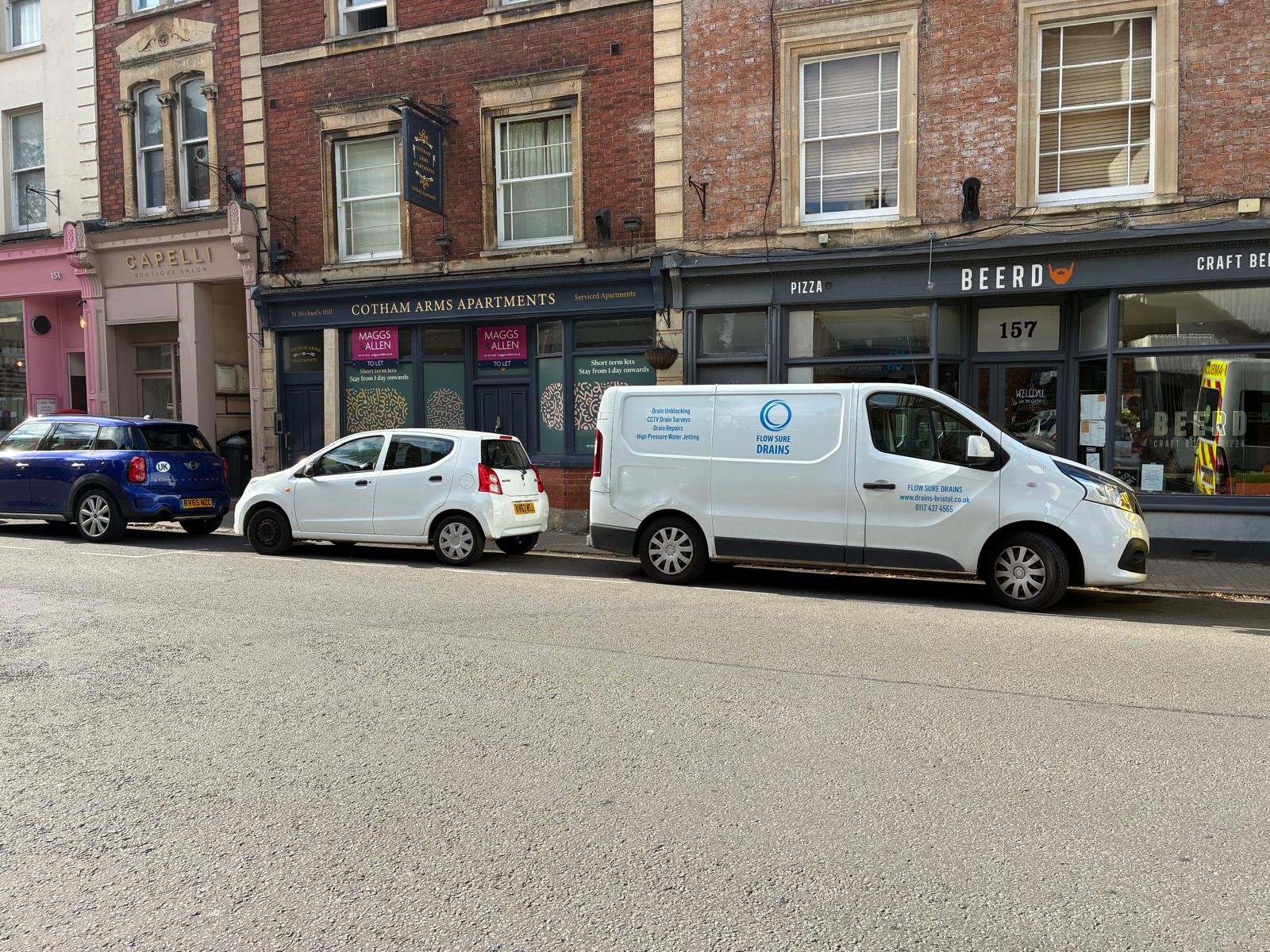
Scheduled maintenance across Bristol’s commercial premises.
Straight answers
Common questions from businesses
How much does commercial drain maintenance cost?
Reactive call-outs start from P.O.A., and planned contracts are priced per visit by site rather than by drain.
We quote a contract after seeing the premises. A single-kitchen café and a four-storey converted block need different frequencies and different work — quoting either without looking would be guesswork.
How often should a commercial kitchen drain be jetted?
A busy restaurant or takeaway typically needs jetting every three months, a café or pub kitchen every six, HMOs and converted flats every six to twelve, and offices or retail units annually.
These are starting points. The right interval depends on covers served, what goes down the sinks and how the run behaves, and we’d set it after the first visit rather than before.
Can you work outside our trading hours?
Yes, and there’s no premium for it. Early mornings before opening and after close are when most of our commercial work happens — the whole point of planned maintenance is that it doesn’t interrupt trade.
Do you need someone on site to let you in?
Not necessarily. Where access can be arranged — a gate code, a keyholder arrangement or external chambers only — we can attend and report without anyone being there. Many of our managing agent and landlord jobs work exactly that way.
Do you invoice, or is payment due on the day?
We invoice, and we work to purchase orders where your process requires one. No card payment on the day is needed for commercial work.
Are we legally required to manage grease?
Under the Water Industry Act 1991 it is an offence to discharge anything into a public sewer likely to damage it or interfere with the free flow of its contents, which covers fat and grease from commercial kitchens. Water companies can require premises to fit and maintain grease management equipment and can act where a business causes repeated blockages.
This is general guidance rather than legal advice — check your specific position with Wessex Water. In practice, a maintenance record showing regular jetting is the most useful thing to have if the question ever arises.
Who pays for a blocked drain in a rented property?
Section 11 of the Landlord and Tenant Act 1985 places a repairing obligation on landlords covering sanitation installations and the drains serving them. A blockage caused by disrepair is generally the landlord’s responsibility rather than the tenant’s.
Where the run serves several properties it may be a shared lateral drain and Wessex Water’s responsibility instead — which is worth establishing before anyone pays for a repair.
Do you handle multiple sites?
Yes. Portfolios are priced per property with a single point of contact and one consolidated invoice. Send us the addresses and we’ll come and look at each before quoting.
Related
What a contract usually includes
Drain jetting & cleaning
The core of any maintenance contract. Grease lines cleared back to full bore before they restrict, rather than after they stop.
CCTV drain surveys
Pre-lease surveys before you take on a building's drainage liability, and diagnosis when a site keeps failing in the same place.
Emergency call-out
Contract customers get priority attendance. But the aim of a contract is that you need this far less often.
Send us the address and we'll come and look
No charge for the visit, and no obligation. We’d rather quote a contract after seeing the drains than guess at one over the phone — and if planned maintenance isn’t worth it for your premises, we’ll tell you that too.